Thermal bonding in nonwoven production is the use of heat — with a spray binder or low-melt fibre where needed — to soften part of the material and weld the fibres together at their crossing points, turning a loose fibre web into a fabric with real strength. Heat reaches the web two ways: pressed through the gap between two heated rollers (calender bonding) or blown through the web as circulating hot air inside a drying chamber (through-air). Which route you take decides whether the fabric comes out thin and firm or thick and lofty.
How thermal bonding differs from needle punching
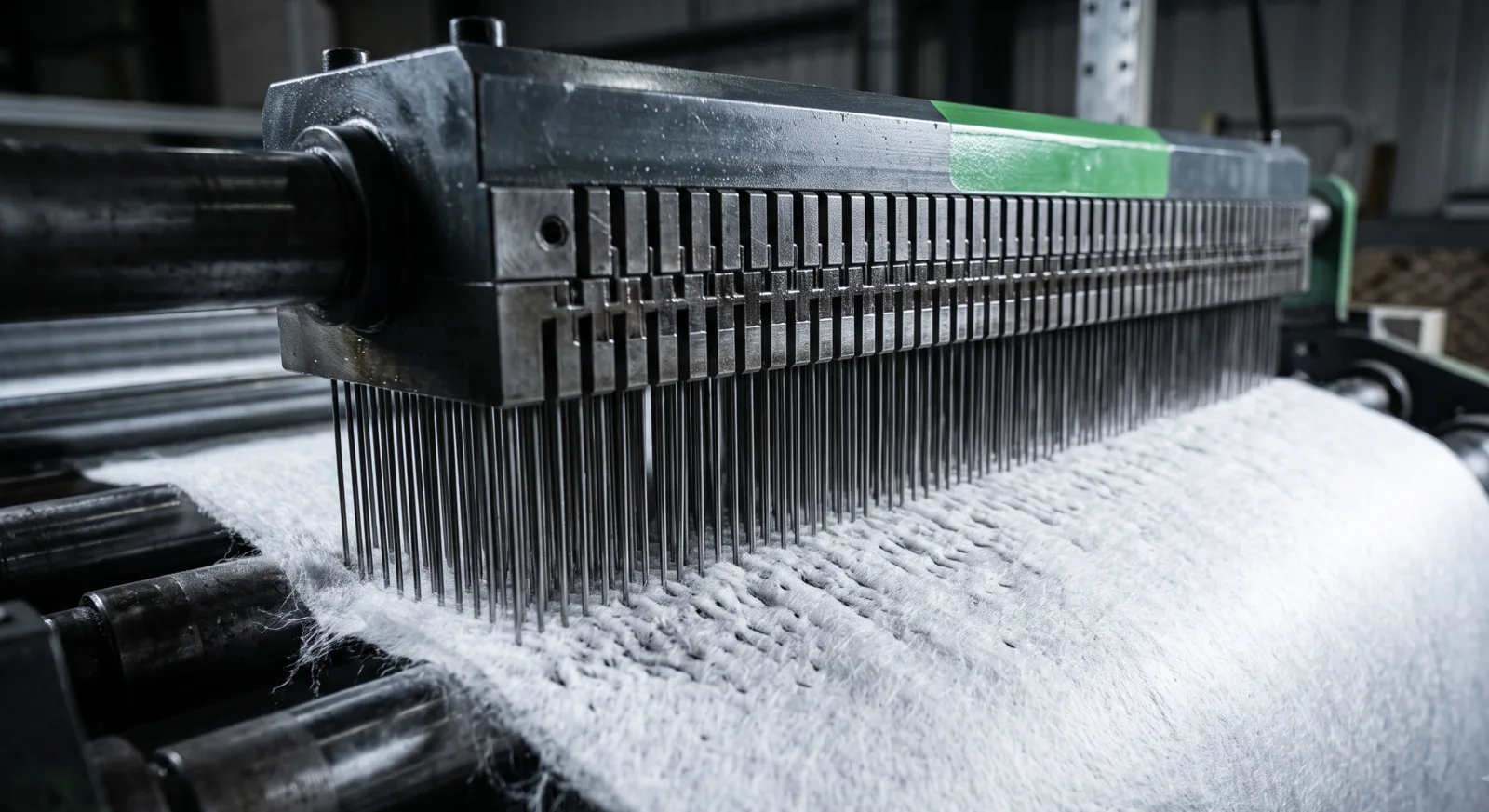
- Needle punching bonds mechanically: barbed needles push through the web, hooking and entangling fibres. The fibre never changes state, so the fabric stays thick and strong in tension — full walkthrough in the needle-punch nonwoven production process.
- Thermal bonding bonds through the material itself: part of the fibre, or a binder sprayed onto the web, melts and then sets into point welds.
The two are complements, not rivals. Plenty of needle-punch lines put a heated calender at the end for surface finishing, while a wadding line does no needling at all and relies entirely on binder plus a drying chamber. See also Needle-punch or Spunbond: which technology should you choose?.
Two ways to deliver heat: calender vs through-air
| Criterion | Calender bonding | Through-air drying |
|---|---|---|
| How heat arrives | Web pressed through the nip between two heated rollers | Circulating hot air forced through the web |
| Pressure | Yes — the web is compacted | Almost none |
| Thickness after treatment | Reduced; pressed thinner | Preserved, or only lightly shaped |
| Surface & hand feel | Smooth, glossy, firm, slightly stiff | Soft, open, resilient |
| Typical fabrics | Artificial leather substrate, filter media | Spray-bonded wadding, stiff wadding, mattress padding |
One rule to remember: pressure costs loft. That makes a through-air chamber the only option for anything that has to stay resilient.
Low-melt fibre and binder: the welding agent
Heat alone bonds nothing — something has to flow and grip the fibres:
- Low-melt fibre blended into the fibre mix upstream; under heat, the low-melt component softens and welds the base fibres at their crossing points. Advantages: a clean fabric, no solvents, no binder effluent to treat.
- Sprayed binder, applied to the web before it enters the chamber. The chamber then does double duty — driving off moisture while curing the binder and locking in loft. This is the principle behind the spray-bonded wadding family.
The low-melt blend ratio and binder spray rate depend on fibre type, fabric weight and the strength each order demands, so they have to be dialled in by trial running your own raw material.
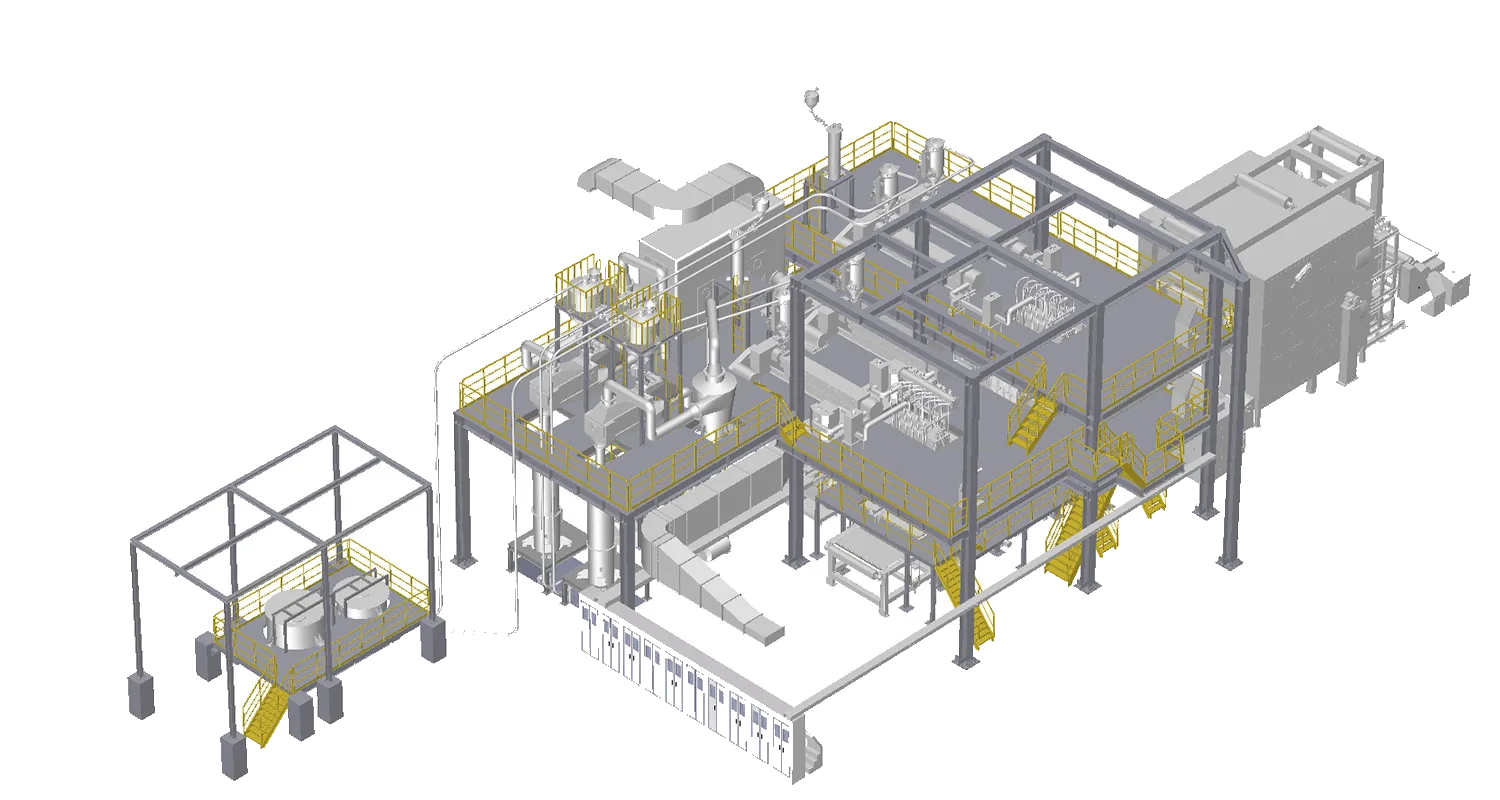
The four machines in the thermal bonding & drying section
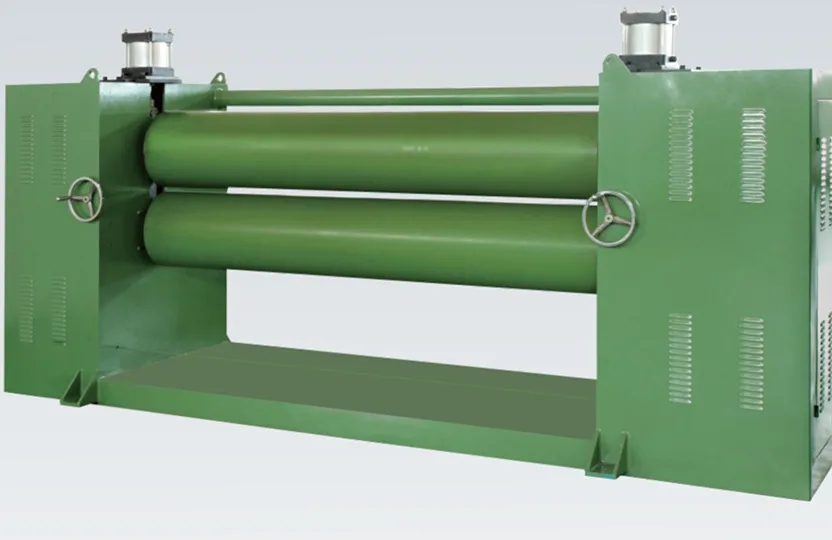
Hot rolling calender
The hot rolling calender presses material through the nip between two heated rollers to compact, smooth and stabilise the surface. The heating roller is heat-resistant alloy steel with a hard chrome-plated surface, the roller gap is adjustable, and a safety stop switch is fitted. Working width 1800~3800mm, roller surface temperature ≤220℃, working speed ≤15m/min. Built for artificial and synthetic leather substrate and filter media.
Ironing machine
The ironing machine passes wadding through the gap between two heated rollers to produce a flat, even, glossy surface before winding. Its roller is stainless steel with a non-stick Teflon coating — essential when the web carries binder, because hot binder readily picks up on bare metal. Working width 1800~3800mm, roller surface temperature ≤220℃, working speed ≤15m/min. It handles spray-bonded and glue-free waddings; placed after the needle loom, this is the unit that presses thickness to size and smooths the surface.
Spray-bonded waddings drying machine
The spray-bonded waddings drying machine is through-air drying in its purest form: once sprayed, the wadding travels through the chamber to lose moisture, take shape and set its loft. It combines a 3-pass drying zone with hot-air circulation, a double-layer stainless-steel hopper, an abrasion-resistant stainless-steel track and strong insulation. Working width 2600~4100mm, chamber length 8000/10000/12000mm, heating by circulated hot oil or direct burning, working speed ≤15m/min. Output goes into garments, bedding and furniture.
Stiff waddings drying machine
The stiff waddings drying machine dries and presses to shape at once, holding a consistent stiffness. Its defining mechanism is a double-layer Teflon-coated chain board whose upper layer lifts independently — that is what sets finished thickness — plus two high-pressure circulation blowers and strong insulation. Working width 2600~3800mm, chamber length 4800~6000mm, heating by circulated hot oil or direct burning, working speed ≤15m/min. Output serves bedding, furniture and high-quality mattresses.
What thermal bonding changes in the fabric
- Thickness. Anything with a nip (calender, ironing) presses the fabric thinner and more uniform; through-air drying alone preserves loft.
- Strength. Heat welds add bonding where barbed needles cannot hold, so the fabric resists pulling apart and sheds less fuzz.
- Hand feel. High heat plus high pressure gives a firm, slightly stiff fabric; low heat with no pressure gives a soft, resilient one.
- Surface. Heated rollers flatten fibre ends and produce an even gloss — decisive for any fabric destined for a downstream coating step.
The three levers you actually control are roller temperature, roller gap and line speed — the same machine yields three different fabrics depending on how you set them.
When does a line need thermal bonding?
- Required — the product is spray-bonded wadding, stiff wadding or mattress padding: no drying chamber, no product.
- Required — the fabric must be smooth, thickness-stable or coated downstream: artificial and synthetic leather substrate, filter media.
- Worth adding — you want more strength and less surface fuzz on needle-punched fabric without raising needle density.
- Skippable — coarse geotextile, where the customer buys thickness and tensile strength rather than surface finish.
Put another way: pin down your finished product and whatever process follows it first, then choose between a calender and a through-air chamber.
Vina Nonwoven is the authorised Zhentai representative in Vietnam, supplying the complete thermal bonding and drying section for nonwoven lines with local installation, commissioning, operator training and warranty. Tell us what you plan to produce and the working width you need — call our hotline or message us on Zalo for a quote.