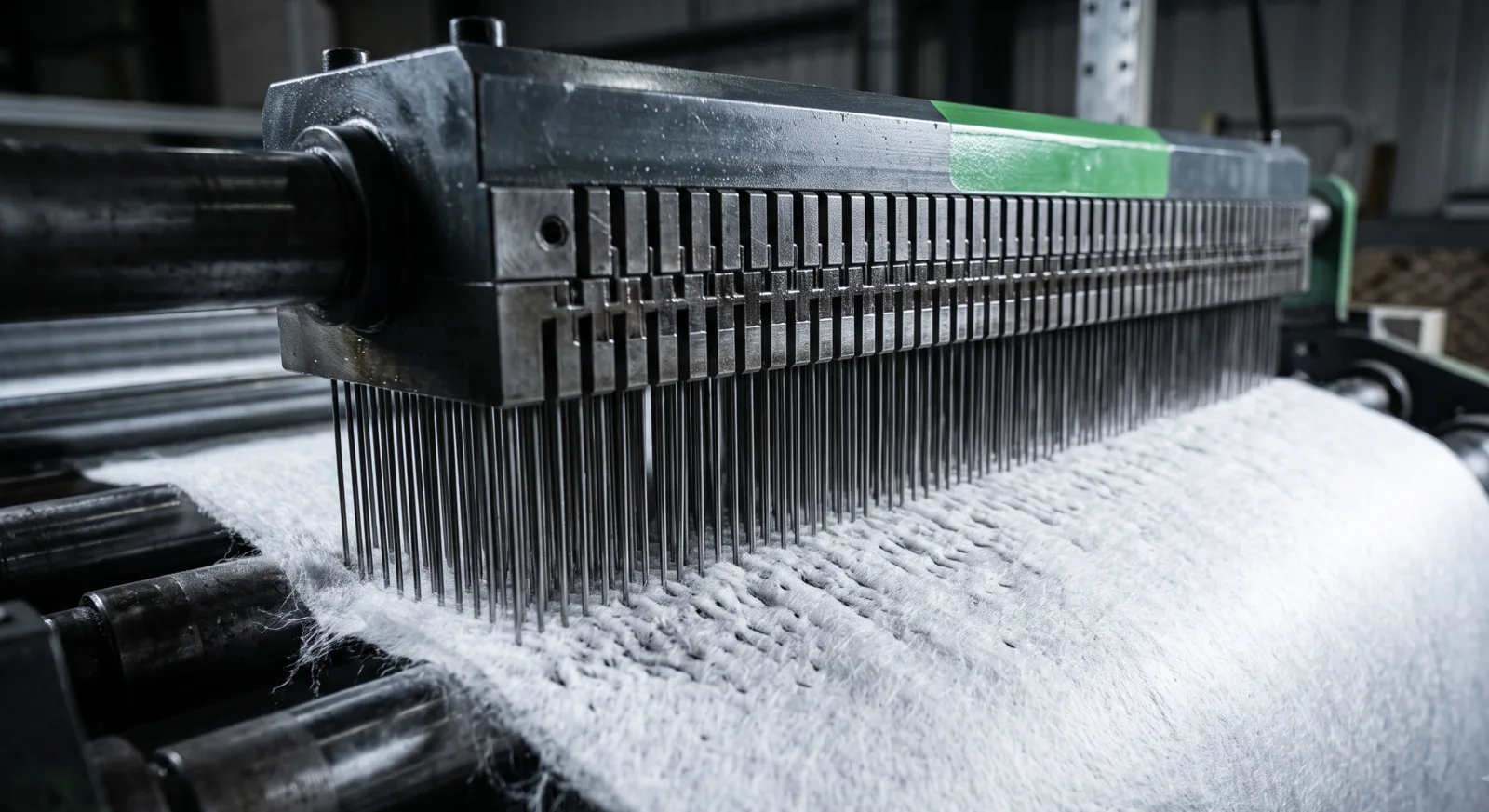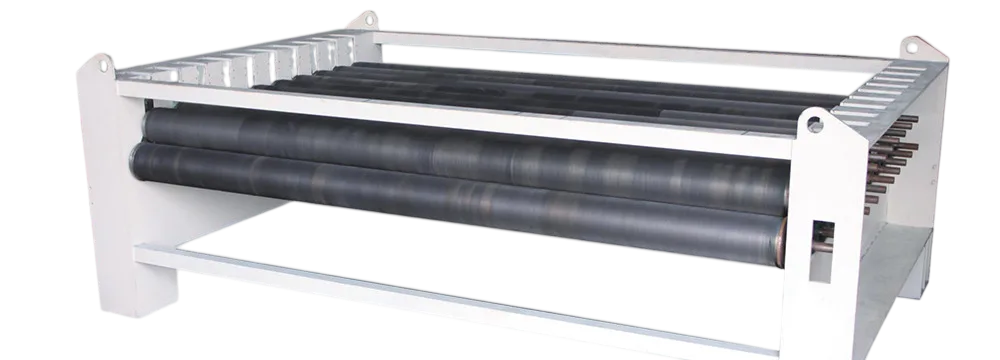
A drafter is the unit in a nonwoven line that stretches the already-needled web lengthwise, optimising the batt’s uniformity and its machine-direction to cross-direction (MD:CD) strength ratio before it goes on to finish needling. It works through a series of roller groups running at progressively higher speeds: the web moves faster through each group than the one before, so it elongates and part of its fibre is re-oriented toward the machine direction. The result is fabric with balanced strength in both directions and better dimensional stability.
Where the drafter sits in a nonwoven line
In a needle-punch nonwoven line, web forming normally runs in this order: carding → cross lapper → pre-needling → drafter → finish needling → winding.
That position is dictated by how the cross lapper works. The lapper folds the carded web into many layers in a Z pattern, which leaves most of the fibre lying at an angle close to the fabric’s cross direction. The batt therefore comes out considerably stronger across the width (CD) than along the machine (MD) — an imbalance that grows with the number of layers and the width of the output apron. Pre-needling only bonds the batt just enough to survive being pulled; restoring the machine direction is the drafter’s job. For more on the stage upstream, see Cross lapper in a needle-punch nonwoven line.
How drafting works: the draft ratio
A drafter is a chain of roller groups that grip the web, each turning a little faster than the previous one. The draft ratio is simply outgoing speed divided by incoming speed: a 1:2 draft doubles the web length and cuts its basis weight (GSM) proportionally. Because the total stretch is divided among several small steps instead of being applied all at once, the web extends gradually without tearing or delaminating.
On the Zhentai drafter that Vina Nonwoven supplies, the control side comprises:
- Drive by an independent variable-speed motor or a servo unit, all under PLC control.
- Draft ratio adjustment at two levels — fine-tuning per group, plus master calibration of the total ratio for the whole machine.
- An upper roller that lifts and lowers independently to set the gap between rollers: tight enough that the web cannot slip, loose enough that the fibre is not crushed.
As for the range, the machine is built in 22007200mm widths, with draft ratios of 1:11:3 on the 5-group unit, 1:11:3.6 on the 7-group and 1:11:4 on the 9-group. More groups means a higher total draft while each individual step stays gentle — which is why lines that need heavy drafting specify the 7- or 9-group configuration.
Why the MD:CD ratio matters
For most needle-punch products, the end customer is not buying high strength so much as balanced strength:
- Geotextiles: acceptance standards specify tensile strength and elongation in both directions, so a one-sided fabric fails the test no matter how strong the other direction is.
- Carpet backing, filter media, industrial felts: a directionally unbalanced fabric creases, winds crooked and develops wavy edges when it passes through calendering or coating.
- Dimensional stability: an undrafted batt carries latent lengthwise stress and tends to shrink under heat or under load in service.
Drafting also gives the line a practical side benefit: it is the last point where basis weight can be trimmed before consolidation. When the batt comes off the cross lapper slightly heavier than the target GSM, nudging the draft ratio up is far quicker than re-tuning the whole carding and lapping set.
Common problems in operation
- Over-drafting. The web thins out too fast and shows streaks, holes or torn edges. Reduce the draft ratio, or move to a configuration with more roller groups so the stretch is split into smaller steps.
- Web slipping on the rollers. The actual draft comes out below the value set on the PLC, so the fabric misses its target GSM. The usual causes are too wide a roller gap or a glazed roller surface.
- Roller gap set too tight. The rollers crush the fibre, the web is pressed flat and loses loft, and strength after needling does not rise as calculated.
- Fibre build-up and static. Fibre clinging to the rollers marks the web surface and can drag whole tufts along with it. Clean the rollers every shift and control humidity, especially with PET fibre.
- Speed out of sync with the neighbouring units. If the drafter’s speed does not match the cross lapper before it and the needle loom after it, the web either stretches to breaking point or piles up and creases between the two units.
How to choose a drafter
- Match the width to the units around it. A cross lapper delivers output aprons up to 2700
10600mm, while the drafter is built in 22007200mm widths — so the target fabric width has to be fixed for the whole line at the outset, not machine by machine. - Pick the roller-group count from the draft you actually need. Settle the MD:CD range your product must hit, then choose the 5-, 7- or 9-group unit whose draft ratio covers it, rather than over-buying capability you will never use.
- Look hard at the controls. Favour servo drive with PLC and per-group fine-tuning: that is what makes product changeovers fast and lets you reproduce a previous batch’s settings exactly.
- Independent gap setting. Coarse fibre for geotextiles and fine fibre for filter media want different roller gaps; an independently lifting upper roller lets you switch products without re-setting the entire machine.
- In-country support. A drafter is an integrated mechanical-and-electrical unit — choose a supplier with an installation, commissioning and warranty team in Vietnam.
Conclusion
The drafter decides whether the batt coming off the cross lapper turns into a directionally balanced fabric or not. Get the width, the roller-group count and the operating draft ratio right and you get fabric that meets its MD:CD specification, holds its dimensions and generates little waste — get the draft wrong and no downstream stage can make up for it.
Vina Nonwoven is the authorized Zhentai representative in Vietnam, supplying drafters, cross lappers and complete nonwoven production lines, with installation, commissioning and in-country warranty — contact us by hotline or Zalo for configuration advice and a quote.